
Trump said that the decision would be "immediately" in effect and that the "order is final and conclusive."

When everyone has footage and no one can verify it, the loudest voice wins, notes Prem Panicker who begins a daily blog on the War in the Middle East.
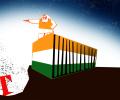
Both countries commit to provide each other preferential market access in sectors of respective interest on a sustained basis

Import duty cuts on labour-intensive sectors such as textiles and footwear, as well as cars, and wines, are likely to be part of the free trade agreement between India and the 27-nation bloc European Union (EU), the conclusion of which is set to be announced on January 27 here, sources said.

Admitting to irregularities in the export of non-basmati rice to some African countries during UPA-I tenure, the government on Friday said it has referred the matter to the CVC after slapping show-cause notices on officials of PSUs, involved in the transactions.

India and the European Union are set to announce on January 27 the conclusion of negotiations and finalisation of a free trade agreement, which is aimed at boosting economic ties between the two regions amid disruptions in global trade due to US tariffs, an official said.
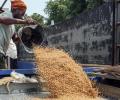
The shortage of rice has led to a food crisis in the UAE, where inflation has climbed above 11 per cent, media reports said. India had, in March this year, banned export of non-basmati rice to check rising prices of the food grain.
The ban on export of wheat and rice may be eased only after the government fulfills the election promise of providing 25 kg of staple food to poor families at Rs 3 a kg, Commerce Secretary Rahul Khullar said.

Withdrawing a blanket ban on overseas shipments of non-basmati white rice, the government on Saturday imposed a floor price of $490 per tonne and exempted the commodity from export duty. Exports of non-basmati white rice have been banned since July 20, 2023 to boost domestic supply. "The export policy for non-basmati white rice (semi-milled or wholly milled rice, whether or not polished or gazed) ...is amended from prohibited to free, subject to MEP (minimum export price) of $490 per tonne with immediate effect and until further orders," the directorate general of foreign trade (DGFT) said in a notification.
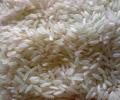
The global body on the farm sector has pegged India's rice production to be lower at 100 million tonnes in the 2012-13 crop year (July-June) from record high of 104.32 million tonnes in 2011-12 crop year.
The European Union has recently introduced a condition on exporters to give a certificate with dispatches that they contain traditional Basmati rice to avail a rebate of 250 Euro per tonne, Lok Sabha was informed on Friday.

New Zealand Prime Minister Christopher Luxon on Monday said the negotiations for a free trade agreement with India have been concluded.

New Zealand has taken a binding commitment under its Free Trade Agreement (FTA) with India to amend its laws within 18 months of the pact's implementation to facilitate the geographical indication (GI) registration of Indian goods besides wines, and spirits in the island nation. The current GI law of New Zealand only allows India's wines and spirits to be registered.
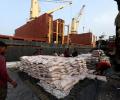
Agriculture, pharma, electronics, and engineering goods together accounted for over 50 per cent of India's merchandise exports in 2024-25, according to government data, highlighting the country's growing strength in diverse sectors amid efforts to boost manufacturing and value-added exports.

India has protected the interest of domestic farmers and MSMEs by not extending any duty concessions on products across several sectors, including agricultural items such as dairy, as well as chocolates, gold, silver, jewellery, footwear, and sports goods, under the trade pact with Oman.
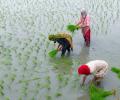
This would be due to early monsoon onset, abundant precipitation in the soil and the government's higher minimum support price (MSP) for farmers, the USDA said in its assessment.
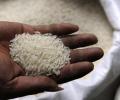
The government on Thursday imposed a 20 per cent export duty on non-Basmati rice except for parboiled rice to boost domestic supplies amid a fall in area under the paddy crop in the current Kharif season. According to a notification by the revenue department, an export duty of 20 per cent has been imposed on 'rice in husk (paddy or rough)' and 'husked (brown) rice'. The Central Board of Indirect Taxes & Customs further said the export of 'semi-milled or wholly-milled rice, whether or not polished or glazed(other than Parboiled rice and Basmati rice)' will also attract a customs duty of 20 per cent.

Non-basmati white rice accounts for nearly 25-30 per cent of total rice exported from the country.

The varieties will take at least 4 to 5 years to reach farmers after they complete the usual cycle of breeder, foundation and certified seeds.
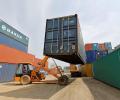
After registering a positive growth for two months, India's exports slipped into negative territory again, contracting 2.17 per cent year-on-year to $38.73 billion in May due to a fall in global petroleum prices, while trade deficit narrowed at $21.88 billion during the month.
These decisions were announced by food and agriculture minister Sharad Pawar in the Rajya Sabha on Friday, a day after Prime Minister Manmohan Singh and his cabinet colleagues were briefed on the monsoon situation and Kharif sowing. Allaying fears of shortage of foodgrain, Pawar said, "Stock position is quite comfortable. We have sufficient stock position for 13 months in our kitty".

The Centre on Friday said it will sell 'Bharat Rice' in the retail market at Rs 29 per kg from next week to give relief to the common man and has also directed traders to disclose rice/paddy stock, as part of its efforts to control prices that have risen by around 15 per cent in the last one year. In a press conference, Union Food Secretary Sanjeev Chopra exuded confidence that these two measures along with the various restrictions of exports will help in cooling down the prices. Seeking to dispel market rumours, he categorically said the government has no plans to lift restrictions on rice exports any time soon.

The Russians have termed Putin's visit to India, his first to this country since the outbreak of the Russia-Ukraine war, as 'Druzhba Dosti', which means 'friendship' in Russian and Hindi respectively.
India is a major rice exporting country.

Seafood is one of India's largest agricultural exports after basmati rice and buffalo meat.

India's exports grew marginally by 0.7 per cent to $41.97 billion in March, while the trade deficit stood at $21.54 billion in the month, the latest government data showed on Tuesday.
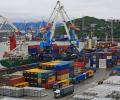
eclined for the third month in a row in January, falling by 2.38 per cent year-on-year to $36.43 billion, while the trade deficit widened to $22.99 billion in the month. Imports rose by 10.28 per cent year-on-year to $59.42 billion in January due to an increase gold shipments, according to the Commerce Ministry data. The trade deficit was $21.94 billion in December and $16.55 billion in January last year.
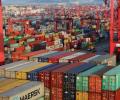
India's exports rose 9.03 per cent to $38.49 billion in April, the highest in six months, driven by healthy growth in sectors such as electronics and engineering goods, while the trade deficit widened to a five-month high of $26.42 billion. According to the commerce ministry data released on Thursday, imports increased by 19.12 per cent year-on-year to $64.91 billion in April due to a rise in shipments of crude oil and fertiliser.

India's exports to Iran have been falling over the last one year, amid decline in rupee reserves of the West Asian economy. Going ahead, the possibility of augmenting exports to Iran may not be easy for India, considering the geopolitical tensions - Russia-Ukraine and Israel-Hamas conflicts - and the West Asian country's support for Russia and Hamas, people aware of the matter said. Exports to Iran saw a downward spiral since November last year.
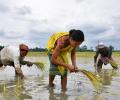
In the coming months, globally as well as in India, rice might remain a hot potato.

After imposing 20 per cent export duty on non-basmati rice, the government has banned the export of broken rice with an aim to increase domestic availability, according to a government notification.
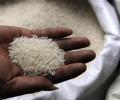
The Russia-Ukraine war is likely to improve the export profile of landlocked Chhattisgarh, which has already nearly tripled during the past three years. Chhattisgarh's exports reached Rs 25,241.13 crore in the financial year 2021-22 against Rs 9,067.92 crore worth of products shipped in 2019-20, according to the state government's data. While exports of iron and steel surged seven and a half times, rice shipping increased 4.68 times.

State governments have requested the Centre for export incentives, lifting of import duty in the case of cotton for the textile sector and GST exemptions.

India's fresh restrictions on limiting access to Bangladeshi exports appear to be in response to Dhaka denying certain value-added items from the Northeast to enter that country through the land transit points.

'What we need to watch is how Saudi Arabia's financial assistance will be used by Pakistan. If the funds go to build their military hardware and operations, it should worry us.'
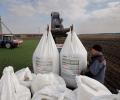
'China reduced its exports of urea to India gradually.' 'In 2020-2021 we imported 28 lakh tonnes of urea which reduced to 16 lakh tonnes in 2022-2023 and that has now reduced to 1 lakh tonnes in 2024-2025.'
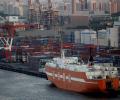
India's merchandise exports dipped by about one per cent to $38.01 billion in December 2024 against $38.39 billion a year ago, according to government data released on Wednesday. Imports increased by 4.8 per cent to $59.95 billion in December 2024 compared to $57.15 billion in the year-ago month.
India has defended its decision to ban export of wheat and rice at a WTO meeting even as some member countries have flagged concerns over the country's stand, an official said. At a meeting last week in Geneva, Senegal, the US and the European Union raised questions over this decision, stating it could have adverse implications on global markets. In May, India restricted export of wheat to enhance domestic availability.
Very sensitive items -- such as apples, which carry political weight and are closely tied to farmer interests in states like Himachal Pradesh and Uttarakhand -- may face restricted concessions.
 © 2026 Rediff.com - Advertise with us - Disclaimer - Privacy Policy - Sitemap - Feedback - About us - Terms of use - Grievances